
自律覚醒人工知能の核心(特許取得)
自律覚醒人工知能:自由度や拡張性が非常に高いAI稼働中に設計ルール知識を追加
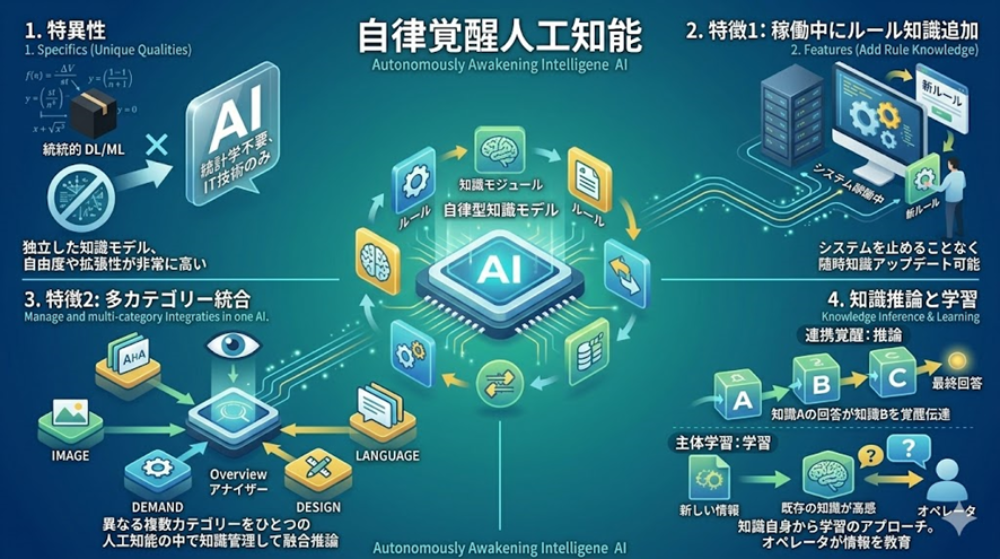
自律覚醒人工知能は、従来のディープラーニングや機械学習とは異なり、知識が独立して存在する自律型知識モデルの環境で動く日本特許の新しい人工知能です。
1.特異性
自律覚醒人工知能の知識は自律型なので自由度や拡張性が非常に高い学習や推論を実現します。その結果、システム稼働中でもルール知識を追加変更でき、多様性なカテゴリーの情報を融合して同時に推論することができます。また統計学などの学識を必要とせずに従来のIT技術だけでAIシステムを構築することが可能です。
2.特徴(従来AIとの違い)
特徴1:AIシステムの稼働中にルール知識を追加変更できること
自律覚醒人工知能では、従来AIとは異なる自律型知識モデルの環境で動くので、システムを稼働させたままルール知識の追加や変更が可能です。これにより、稼働当初は少ない知識で動かしながら、徐々にルールや知識を増やして、システム知能を高度に育てる開発運用を計画することができます。
特徴2:多様性なカテゴリー情報を俯瞰的に扱えること
自律覚醒人工知能では、従来AIとは異なる自律型知識モデルの知識で動くので、異なる複数カテゴリーをひとつの人工知能の中で知識管理して、必要な知識を融合して推論することができます。また知識をパッケージ化することも可能です。これにより、多様性なカテゴリーで構成される情報環境でも、個々のカテゴリーで情報を知識管理しながら俯瞰的な分析や予測を行うことができます。
3.知識推論の方法
自律覚醒人工知能は連携覚醒の作用で推論を行います。自律型知識モデルの基本的な推論作用は、独立した知識でルール知識の覚醒推論が行われ、知識が持つ回答を活性化します。またその回答が他の独立した知識の入力となり覚醒推論されて回答を活性化します。このように人工知能の中で、知識から知識へと推論作用が伝達していきながら最終回答を導き出します。
4.知識学習の方法
自律覚醒人工知能の学習は知識自らが駆動する主体学習の作用で行います。自律型知識モデルの知識は、ルールやカテゴリーの情報を増やすと、関連する既存の知識が新しい情報についての学習意欲が高まり、知識自身から学習のアプローチを行います。そしてオペレータや周辺装置は知識が求める情報を教育します。もしくは、初期構築時に基本的な知識を学習させた後に主体学習で知識を高めることも可能です。
特許情報
特許番号:特許第7193870号
発明名称:人工頭脳システム及びそれに用いられる智識装置 (自律覚醒人工知能理論)
Autonomous Awakening Artificial Intelligence
Autonomous Awakening Artificial Intelligence is a new Japanese-patented AI that operates in an environment of autonomous knowledge models where knowledge exists independently, differing from conventional deep learning and machine learning.
1. Specificity
The knowledge of autonomous awakening artificial intelligence is self-governing, enabling highly flexible and scalable learning and reasoning. Consequently, rule knowledge can be added or modified even while the system is operational, allowing it to fuse information from diverse categories and perform simultaneous reasoning. Furthermore, AI systems can be built using conventional IT technologies alone, without requiring expertise in fields such as statistics.
2. Features (Differences from Conventional AI)
Feature1: Ability to add or modify rule knowledge while the AI system is operational
Autonomous Awakening Artificial Intelligence operates in an autonomous knowledge model environment distinct from conventional AI, enabling the addition or modification of rule knowledge while the system remains operational. This allows for a development and operation plan where the system initially runs with minimal knowledge, gradually increasing rules and knowledge to cultivate highly advanced system intelligence.
Feature2: Ability to holistically handle diverse category information
Autonomous Awakening Artificial Intelligence operates using an autonomous knowledge model distinct from conventional AI. This enables it to manage knowledge across multiple, disparate categories within a single AI system, fuse necessary knowledge for inference, and package knowledge. Consequently, even within information environments composed of diverse categories, it can perform comprehensive analysis and prediction while managing knowledge within each individual category.
3. Methods of Knowledge Inference
Autonomous awakening artificial intelligence performs inference through collaborative awakening. The fundamental inference process of the autonomous knowledge model involves awakening inference of rule knowledge using independent knowledge, thereby activating the responses held within that knowledge. Furthermore, these responses become input for other independent knowledge, triggering awakening inference that activates their responses. In this manner, within the artificial intelligence, the inference process propagates from knowledge to knowledge, ultimately deriving the final response.
4. Knowledge Learning Methods
Autonomous awakening artificial intelligence learns through self-driven learning, where knowledge itself initiates the learning process. When rules or category information is added to the autonomous knowledge model, related existing knowledge becomes more eager to learn about the new information, prompting the knowledge itself to approach learning. Operators and peripheral devices then educate the knowledge with the information it seeks. Alternatively, it is possible to initially teach basic knowledge during initial construction and then enhance the knowledge through self-driven learning.